Friday, July 20, 2012

Newton's Cannonball


A deafening boom. A rush of air. The smell of gunpowder. And suddenly a cannonball was arcing through the air. This hypothetical cannonball, launched by Isaac Newton in a thought experiment, could be considered the shot-heard-'round-the-world heralding the arrival of the theory of gravitation.
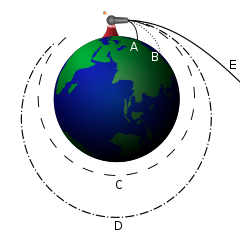
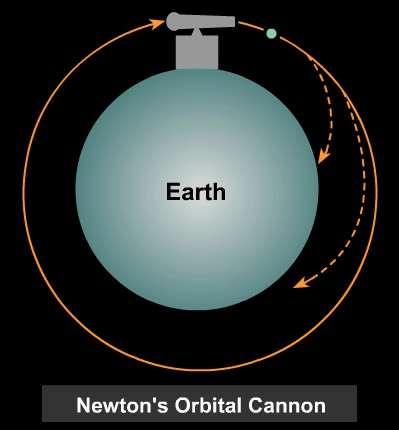

Newton reasoned if one shot a cannonball off the top of a mountain at a relatively low velocity, it would travel some distance and fall back to Earth. Faster velocities would mean the ball travels farther before it hits the ground. But of course, Newton did not stop there. What if the radius of the ball’s trajectory curve matched the radius of the Earth? The ball must keep falling, but it would never reach the ground. Essentially, it would orbit. So technically, we are falling around the sun, while the moon falls around the Earth! This particular thought experiment that led to Newton’s theory of gravity was only made known after his death. He published very few works, though they were in high demand by some scholars; most of his writings were released only posthumously. But those he did publish, like the enduring Principia in 1687, sent waves through the scholarly community.
Though there were only a few hundred copies in print, Principia could be heard discussed in coffee-houses across England. It held so much information on so many different arenas of science and mathematics, that Marquis de l'Hopital declared of Newton, “Does he eat and drink and sleep? Is he like other men?”

Indeed, Newton was not like other men. As a teenager, he was constantly inventing curious contraptions, such as a mouse-powered miniature windmill, and doodling sketches of animals, people, and shapes on the walls of his boarding home. It says something of his brilliance that in grammar school, he was never taught natural philosophy and only basic forms of arithmetic and math, and yet approximately four years later he discovered calculus! He was raised in a relatively well-off economical situation, but his life was devoid of human connection. Raised by his grandmother, his father passed away before his birth, and his mother left her only son for a new husband many years her senior. In grammar school, the other boys were everything but friendly--likely put-off by Newton's unusual intellectual superiority. Lacking friends at such a young age, he devoted all mental faculties to the pursuit of sciences, and having been scorned by his peers, he carved his name into every school bench he occupied. Later in life he would suffer from several breakdowns, causing his contemporaries to question the soundness of his intellectual abilities. Newton was thus an enigma to those around him. His wildly creative nature was incomprehensible to many, leaving him quite alone.

Through all this, Newton found solace and inspiration in God. While working on Principia, he and one of his few friends, John Locke, would exchange letters, in which Newton would dissect various Biblical passages and their meaning. Newton’s view on the physics of the universe, similar to Kepler’s, were strongly connected to his devout, yet unorthodox Christianity. He would point to God as the answer to many cosmological curiosities, such as how "dark matter" (planets, rocks) was so distinctly separated from "light matter" (the sun, stars): "I do not think explicable by mere natural causes but am forced to ascribe it to the counsel and contrivance of a voluntary Agent."
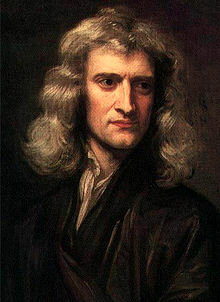


Surviving through an emotionally turbulent childhood, Newton first studied mathematics until the Great Comet of 1680 turned his eyes heavenward.  Johannes Kepler's existing three laws of planetary motion provided a basis and reference for Newton to postulate his own three laws of universal motion.  Newton set off to discover the force which consistently drew objects downward, toward the center of the Earth. The theory of gravitation was, consistent with the famed legend, born out of a contemplation of the trajectory of a falling apple (though the apple never actually hit him on the head), which later spawned the cannonball theory. And, if gravity worked on the Earth, why shouldn’t it be applied to the moon and the rest of the cosmos? Newton declared that the heliocentric model was in fact correct, with one caveat. It was not the Earth that revolved around the Sun, nor the Sun that revolved around the Earth, but rather, both revolving around the system's center of mass. In his own words, "the common centre of gravity of the Earth, the Sun and all the Planets is to be esteem'd the Centre of the World."


For all his eccentricity, Newton died quietly in his sleep in 1727. His equations for the motions of the planets and other celestial bodies are crucial foundations for exoplanetary science. In addition, his stipulation that components of a system orbit about a center of mass is the cornerstone of the radial velocity method of detecting planets. His crowning achievement is his theory of gravity, and if you were to fire a cannonball from the top of a mountain today, you’d find that the results would not have changed from Newton’s original postulations. However, almost 200 years later, gravity would be radically expanded to address high energies and speeds, permanently changing our perspectives on astrophysics by a German man with disheveled hair, who would come to be known as the father of modern physics: Albert Einstein.

“I do not know what I may appear to the world, but to myself I seem to have been only like a boy playing on the sea-shore, and diverting myself in now and then finding a smoother pebble or a prettier shell than ordinary, whilst the great ocean of truth lay all undiscovered before me.”
Isaac Newton

Monday, July 16, 2012

Kepler: The Archetypal Nerd


Modern technology has enabled us to find thousands of planets orbiting stars other than our own Sun, only within the past few decades. Most of these planets fall into three broad categories: ice giants, gas giants, or hot super-Earths. The most intriguing kind of exoplanet, the holy grail of exoplanet discovery, Earth-like planets in their respective habitable zones, is less commonly found. The Kepler Mission is a NASA Discovery mission that is responsible for finding a majority of the planetary candidates we know of today, and is designed to find these diamonds in the rough over the course of its full mission lifetime. Kepler has taken us leaps and bounds beyond the big puffy hot-Jupiters we were first aware of, and its success is taking large steps toward discovering extraterrestrial life. So who was the eponym, Kepler? It’s a name we’ve all heard, but it doesn’t carry with it the same stories the other giant names of science carry: Newton’s apple, Galileo’s finger, Archemides’s “Eureka!”

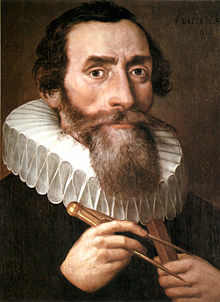
Contrary to popular belief, Kepler is not holding chopsticks

There is not much hype about Johannes Kepler, and perhaps that's because at first he just wasn't the most popular guy. Being born premature and constantly sick wasn't really conducive to running around with the other boys in grammar school, and his bookworm tendencies left him with few admirers. As a bit of a misfit, he set himself to the pursuit of knowledge, and while the others would ridicule him, Kepler voraciously set his mind to a myriad of subjects, such as poetry, astrology, theology, and mathematics . He kept a detailed daily journal, and many sections were on his quarrels with and hatred for his classmates. As he would write later, "they were always rivals in worth, honors, and success.” Yet for all the disapproval, Kepler’s unorthodox approaches to problems were an advantage in his scientific endeavors. He was one of the first to defend the Copernican heliocentric system using a theological basis, and he consistently came out on top intellectually. His first landmark work, Mysterium Cosmographicum, in which he discussed the geometry of the universe, was published when he was only twenty-four.

Like Newton, who would come into the picture some fifty years later, Kepler’s early life was marked by a combination of scientific brilliance and childhood unpopularity, and also like Newton, he was a devout Christian. Kepler attended seminary for much of his early life, and he was usually not far from a theological text. In fact, in all of his scientific achievements he would take both a philosophical and mathematical approach, believing that the cosmos was the ultimate revelation of the glory of the creator. Even his defense of the heliocentric model of the universe had its theological foundations. Seeing the universe as a portrait of God, he viewed the Sun as symbolic of God the Father, the "stellar sphere" as the Son, Jesus, and the space in between everything as the Holy Spirit. This was all originally included in Mysterium Cosmographicum, until his publisher later removed it. He journaled regularly about his daily life, which has been quite useful for modern historians. He was as much of a philosopher as a scientist, and he frequently combined the two disciplines. Always remaining true to his theoretical side, he wrote in a letter, “Don't sentence me completely to the treadmill of mathematical calculations. Leave me time for philosophical speculations, my sole delight!” Arthur Koestler writes in his modern biography of Kepler: “[he was] the most reckless and erratic spiritual adventurer of the scientific revolution.”

In the midst of his theological studies however, he was asked to teach mathematics, and accepted a position at a Protestant school in Austria. It was there he completed Mysterium Cosmographicum. Henceforth he held many prestigious positions, including the one previously held by Tycho Brahe of Imperial Mathematician. Brahe’s death allowed Kepler access to his highly protected data, thus heralding Kepler's most prolific age. In Astronomia Nova, he published his first two laws of planetary motion:
1. Every planet follows an elliptical orbit with its host star at one focus.
2. A line drawn from the star to the planet sweeps out equal areas in equal times.
Despite all his mathematical genius, his works were praised by few and scoffed at by many. There was much discussion over the first law. Some of Kepler’s contemporaries believed that this shattered the “circularity and uniformity of motion” and could not comprehend the depth of the work he had done. And when Kepler theorized that the moon had influence upon the tides, Galileo himself remarked, “That concept is completely repugnant to my mind.” Still, he rose to fame as a scholar.


Ten years after the publication of the first two laws, Kepler’s third law, arguably the most significant for modern planetary scientists, was unveiled in his book Harmonices Mundi.
3. The square of the orbital period is directly proportional to the cube of its semi-major axis.
This law, made concrete by Newton as 
 
is an essential ingredient to our modern understandings of planetary systems. And ever the philosophical scientist, Kepler also discussed literally the “music of the spheres” in which he revealed the physical harmonies found in the motion of planets.

As a Protestant during The Thirty Years War, 1618-1648, Kepler was forced to leave his home and travel during his last years. He died without pomp and circumstance, but his work would build a foundation for great scientists to come. Though Kepler now is considered one of the keystone figures of the Scientific Revolution, at the time he was criticized for combining physics and astronomy, generally considered two separate branches of philosophy and natural science. He was one of the first to see the necessity to link philosophy and science, and he remained a devout Christian to the end. His life shows that philosophy, theology, and the scientific method aren’t necessarily mutually exclusive; in fact for Kepler, each was essential for a complete and holistic perspective on the others.


I measured the skies, now the shadows I measure
Skybound was the mind, earthbound the body rests.”
Kepler’s epitaph

Tuesday, July 10, 2012

Giordano Bruno: Exoplanetary Martyr


Nicolaus Copernicus’s On the Revolutions of Heavenly Spheres marked the beginning of a major shift in Western thought. Concepts of perfection and heaven at that time were deeply rooted in the religious political structure that prevailed throughout the Middle Ages and were tied to ideas about the ultimate fate and purpose of human life. The existence of planets alone was no threat to the dogma of the Catholic Church; the Greek origin of “planet” translates literally into “wandering star,” and Earth could still be viewed as the heart of the cosmos through a complicated mathematical scheme for the paths of Mercury, Venus, Mars, Jupiter, and Saturn. But as Copernicus knew, to categorize our own home, Earth, as merely another planet was dangerous, and he cleverly dodged a certain fate by waiting for a posthumous publication of his monumental work. This fate was passed on five years after his death in 1543 to a talented Italian born Filippo Bruno. Bruno’s insistence that the Sun was a star just like all the others, and that there existed other worlds and other intelligent life throughout the universe, caused quite the controversy.

As a young priest, Bruno could be considered a kind of wandering star himself. Fleeing Naples in 1576 after learning of an impending indictment for his heretical views, Giordano, as he was then known, traveled about Italy seeking shelter for his beliefs. He continued to expand his education, obtaining a doctorate of theology and teaching philosophy, theology, and the art of memorization at various universities throughout Italy and France. Supported by King Henry III and other powerful French patrons, Bruno gained quite a following, despite his views being condemned by the Vatican. Upon finally returning to Venice, he was arrested and imprisoned for seven years, which finally culminated with his death by way of incineration. It has been said that the belief he clung to most strongly, despite pressure by the Church to renounce his claims and repent, was his view that there were multiple and possibly infinite numbers of worlds.


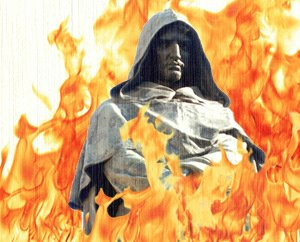
Bruno lives on as a statue in Rome, at the site of his death.

So why was the Church so against this idea, given their acceptance of the five other known planets? The idea of a planet as a world is something unique among astronomical objects. Galaxies, black holes, stars; these are all things, but none, except planets, are actually places. The word "world" connotes humanness, or the affairs of life, such that the existence of other worlds would imply that we are not alone. Though this may have been heretical in the eyes of the Church, it is the root of a philosophical fascination with planets. Our ability to comprehend other worlds and to have a glimpse at understanding our place within an immense vastness—our cosmic context—invokes inspiration, connectedness and awe. The flip side of this is that our new perspective puts us in no particularly special place and our individual scope is considerably diminished. We are not the center of the universe.
We're not even the center of the solar system! What a blow to the ego of humanity!


We know Bruno was correct in one regard—that there are countless numbers of other planets out in the vastness, circling their respective stars just as we are. But his second principle has not yet been verified: are we the lone settlers of the cosmos? Carl Sagan famously referred to Earth as a "lonely speck," and as such, finding life elsewhere in the universe would be a monumental breakthrough, arguably one of the greatest in human history, wholly redefining our ideas on the meaning of life itself!  This discovery would draw the attention of every soul on this planet skyward, and while looking upwards, each would also be compelled to look inwards at himself. "Life as we know it" is a limiting statement in itself; who knows what foreigners may lie beyond our solar system? We are on the hunt to find planets which are more than just objects; we are searching for those that are homes. Twenty years ago, when the first extrasolar planet was confirmed, the door of discovery was flung open wide. Twenty years ago, Bruno rolled over in his grave—figuratively, as his final state was merely a pile of ashes—and triumphantly proclaimed "I told you so!" Now here lies the search for other worlds, stemming back to the 1500's. It is an ongoing investigation, with a colorful history of progressive, and sometimes absurd ideas, but as we pick up steam into the 21st century we press onward, making compelling discoveries into the nature of planets, and by extension, discoveries about ourselves and our own home.

Monday, July 2, 2012

Just Another Planet


In our group meeting last week, Professor Johnson suggested we calculate how much it would cost to “buy” a planet. So we took a look at how much each detection method tends to cost, by noting its budget and how many planets it has found so far. For all the detection techniques--radial velocity, transits (ground and space based) and TTVs, microlensing, direct imaging--it was estimated that each planet found cost around $100,000.

Wait, $100,000?! For a planet? Why would you spend that much money just to find a planet?!

I don’t know about you, but that was my first reaction. Then I realized, with all the research I’ve been doing, that certainly Galileo and other astronomers of that period would be happy to pay $100,000 (or at least, its equivalent, having adjusted for inflation!) to detect an extrasolar planet. Planets were a big deal! In fact, the very suggestion that other inhabited planets existed got Giordano Bruno burned at the stake! So how have we gotten to this point, where just twenty years ago a new planet was huge news, and now it’s just an everyday event? Why should we be spending this much money on finding planets? Comment below with your thoughts and opinions on this matter, and a follow-up post is coming soon!

Wednesday, June 27, 2012

Uncovering the Secrets of the Solar System


The cosmos: ethereal, mysterious, and unfathomable. At least, for a little while. However obscure and mystical the first speculations about the universe were, over time they were no match for astronomers looking through the lenses of empiricism.

Aristotelian "physics" was not physics in the sense we think of now. It was actually a philosophy, one of the most influential theories on the workings of the universe, accepted as the standard work to reference for over 1,000 years. Widely considered one of the greatest thinkers of all time, Aristotle proposed that the universe and the "heavenly lights" were contained in perfect concentric spheres composed of an eternal substance called "aether." However romantically arcane these ideas seem to be, they were obviously not formed from a foundation of deep scientific study. For example, another one of Aristotle’s “truths” was that flies have four legs, which was accepted by scientists for years until someone actually made some basic observations. Similarly, it would require someone to take a good look at the night sky in order to dispel Aristotle’s hypotheses about the universe.

Cue Tycho Brahe, a man as quirky as his nearly unpronounceable name, and yet a brilliant astronomer. Brahe was the first scientist to accurately observe and measure the night sky and its heavenly lights, and thus he refuted much of Aristotle's axioms. In 1572, a supernova that we now know to be 5700 light years away appeared to Brahe as a bright new star in the sky. At the time, it was believed this new star was "in the terrestrial sphere below the moon," meaning it was between the Earth and the moon. Brahe observed that the star had no parallax motion, and thus concluded it must have been past the moon and past all of the planets. Although he was the last and possibly greatest of the naked-eye astronomers, his data was later found to have some observational inaccuracies.  He claimed his measurements were within one arcminute of accuracy, but after his death it was noted that the average error was around two arcminutes, in some cases even three. However, these errors certainly do not overshadow the rest of Brahe’s accomplishments; one of his defining achievements was creating tables that corrected for atmospheric refraction in observation near the horizon. Unfortunately, soon after his remarkable discoveries he suddenly was afflicted by a fatal dose mercury poisoning. It is debated whether this was due to some kind of sinister sabotage from an enemy, or Brahe’s fondness for wearing prosthetic metal noses.


Brahe definitely would have made People magazine's "Sexiest Men Alive" list, if he were alive


After "[living] like a sage and [dying] like a fool" (Brahe's autobiographical epitaph), his data was picked up by his student, Johannes Kepler. In addition to being a mathematics teacher and strong proponent of the Copernican heliocentric system, Kepler was a devout Christian and often related theology and religion to his research on the universe. He used Brahe’s measurements to develop his three famous laws of planetary motion, the most crucial of which to modern planetary science being the third, which states that the square of the orbital period of a planet is directly proportional to the cube of its semi-major axis. His first law states that every orbit of a planet is an ellipse, and these crucial discoveries chipped away at Aristotle’s original theories of perfect heavenly spheres. Brahe and Kepler’s contributions to observational science led the way in the Scientific Revolution, and began to demystify our solar system.

Monday, June 25, 2012

What About Mercury?

The transit of Mercury occurs about thirteen or fourteen times per century. They are much more common than Venus transits, and thus they may get slighted a bit by avid stargazers! So, why do they happen so often?

In general, a planet’s orbital plane can have any orientation relative to our line of sight, but only a fraction of these produce a transit. In order to calculate the probability of a transit, we need to know the range of these specific orientations as a fraction of the total possible configurations.

First, let’s assume that the planet’s orbit is perfectly circular and that its radius is much smaller than the star’s. And for the time being, we assume that the star-planet system is infinitely far away, such that all lines of sight to the system are parallel. Two angles specify all possible orientations of the planet’s orbit, with respect to our line of sight, and we integrate over the ranges of these two angles that produce transits. A two dimensional angle is called a solid angle, which maps out an area in angle-space, and in spherical coordinates this integral looks like:


After dividing by the sphere of total angles, which is simply equal to 4π, we are left with the probability that we will observe a transit,


which is just a function of stellar and orbital radii!

So we see that Mercury, which has a much smaller value of a, will have a higher probability of transit than Venus. In fact, this applies for all stars and their companions. The closer the planet, the more likely a transit is!

Monday, June 11, 2012

The Transit of Venus

 Last Tuesday afternoon marked the last transit of Venus across the sun this century!


 Our solar system was born in such a way that Earth is more-or-less aligned with the orbital planes of the other inner planets between us and the sun: Mercury and Venus. This makes it possible to view from Earth these planets trekking across the face of the sun in what scientists dub a transit. Though you might think this happens pretty often, actually witnessing a transit is a rare event, as Venus's orbital plane is tilted slightly relative to ours. Thus, Venus transits occur in pairs, and though there are only eight years in between the two, the next pair rolls around every 105-120 years!


This is an actual image of the transit taken by NASA!


The transit detection technique is used when a planet passes in front of its star, and there is a consequent drop in the measured luminosity emitting from the star. These drops are graphed and from them, we can discern the planet's mass and orbital period. In addition, a somewhat counterintuitive part of transits is when the planet passes behind the star, and the luminosity of the planet itself (however small) is lost. Transit detections can be so precise, they can detect a drop in the light curve of 1.5%! But what's really cool about the transit method is this: When the planet passes in front of the star, light shines through its upper atmosphere. By observing the resulting spectrum at various wavelengths, we can actually determine the composition of the planet's atmosphere!


Transit detection requires two conditions to work optimally. First, the plane of the orbit must be aligned with the plane of the observer. Second, this method is ideal for very large planets with small orbital radii, as their light curve will be much more pronounced. 


 The Kepler mission is a NASA project that's looking for Earth-size planets within the mysterious "habitable zone" of a star where liquid water can potentially exist. The telescope stares at about 100,000 stars for about 3.5 years, and can detect changes in the light curve up to 1/10,000, or 100 parts per million.


 Check back later for more on the eponym of the Kepler mission, Johannes Kepler, and his contributions to astronomy.


"... the ways by which men arrive at knowledge of the celestial things are hardly less wonderful than the nature of these things themselves." -Johannes Kepler